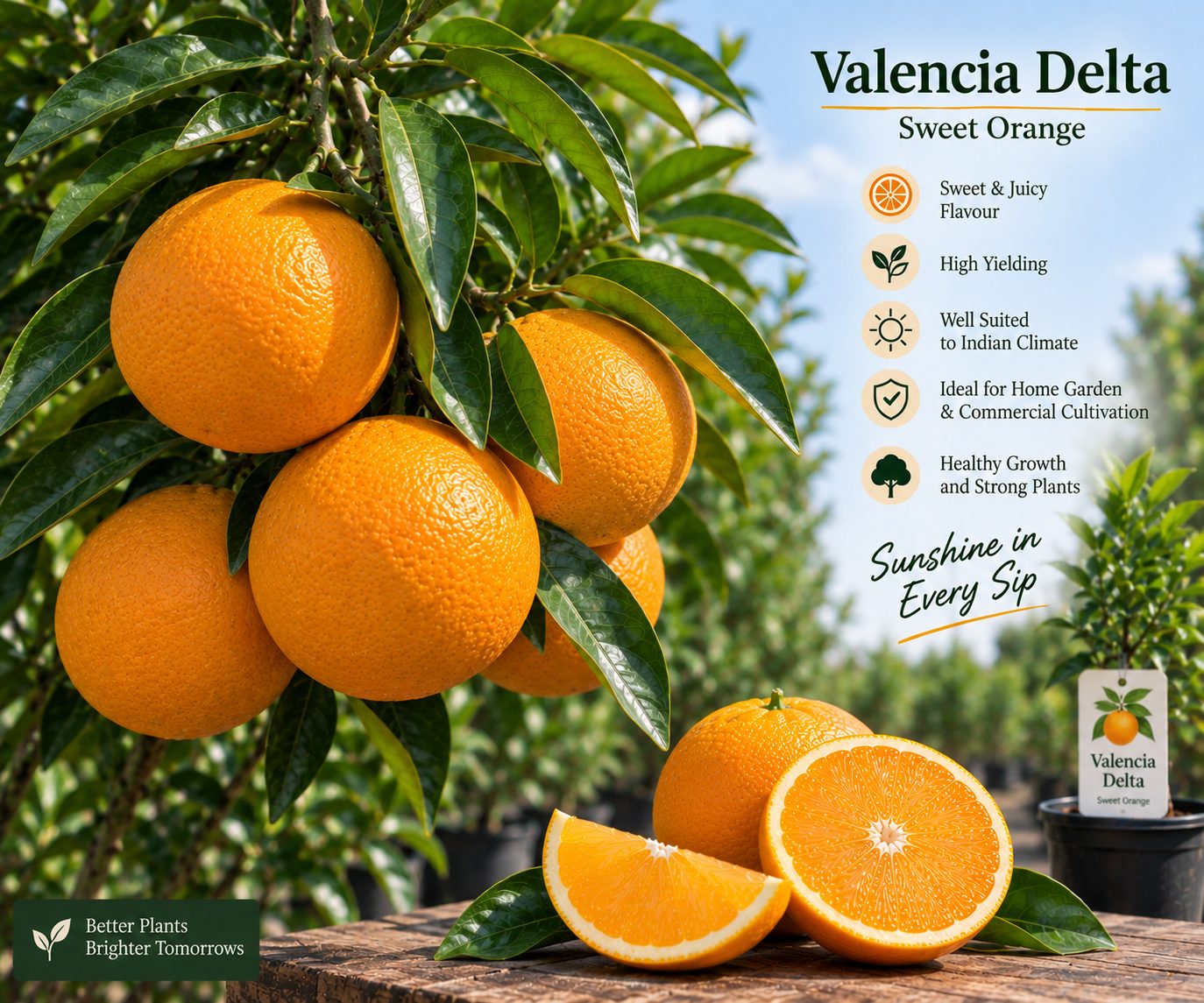
Velencia Delta Care Protocol
Botanical: Citrus × sinensis · Mature orchard height: 10-15 ft
6–8 hours of direct sunlight daily
6.0 – 7.0 (well-aerated, slightly acidic sandy loam)
Keep evenly moist in spring/summer; allow top 2 inches to dry between waterings
16–18 inch container with extra drainage holes or raised orchard bed
18°C – 32°C
Starts bearing in 2–3 years; fruits mature 7–9 months after spring bloom
Beginner · Potting, Drainage & Graft Care
Set up feeder-root aeration so your Valencia / Sweet Orange sapling thrives.
1. Gentle Unboxing & Shade Rest
Rest the sapling in bright shade for 72 hours after delivery. Water lightly and mist the foliage to recover from transit.
2. Citrus-Safe Fast-Draining Medium
Citrus feeder roots sit in the top 30 cm and hate wet feet. Mix 45% garden soil + 25% cocopeat/leaf mold + 20% coarse sand/perlite + 10% vermicompost with 50 g neem cake.
3. Protect the Bud-Union Collar
Plant slightly high (crown 2 cm above surrounding soil) so water never pools against the trunk bark, preventing Phytophthora collar rot.
4. Remove Rootstock Suckers Immediately
Any thorny, trifoliate (3-leaved) shoot sprouting below the graft union belongs to the rootstock—rub it off flush with the stem as soon as it appears.
Advanced · Micronutrient Feeding & Bahar Management
Prevent yellow-vein chlorosis and lock in heavy spring blossom.
1. Chelated Micronutrient Foliar Regimen
Sweet oranges have high demand for Zinc, Iron, and Magnesium. Spray a citrus micronutrient mix (ZnSO4 + FeSO4 + MgSO4, chelated, 2 g/L) on new spring and autumn leaf flushes.
2. Three-Split Organic + Balanced Feeding
Feed in February, June, and October: 2 kg vermicompost + 100 g neem cake + 40 g bone meal + 20 g potassium sulphate around the drip line.
3. Citrus Leaf Miner Shield on New Flushes
Whenever tender light-green leaves emerge, spray Neem Oil (5 ml/L with 1 ml liquid soap) every 7 days for 2 weeks to stop silvery leaf-miner tunnels.
4. Skirt Pruning & Deadwood Removal
Prune off low branches touching the soil (skirt up to 25–30 cm) and remove dry water-shoots to improve airflow.
Expert · Brix Enhancement, Fruit-Drop Control & Phytophthora Defense
Precision orchard techniques for thin-rind, high-juice Valencia & Sweet Orange crops.
1. Controlling Physiological & Pre-Harvest Fruit Drop
At pea-size fruit stage, spray 2,4-D (10 ppm) or Planofix (NAA 4.5 SL at 1 ml per 4.5 L water) + 00:52:34 (5 g/L) to prevent June drop and pedicel weakening.
2. Trunk Bordeaux Paste & Collar Rot Prophylaxis
Twice a year (pre-monsoon and post-monsoon), paint the lower 30 cm of the trunk with Bordeaux paste (1:1:10 CuSO4 : Lime : Water) and drench the root zone with Trichoderma viride (10 g/L).
3. Potassium-to-Nitrogen Ratio for Juice & Sweetness
During fruit expansion (60–120 days before harvest), switch to high-K foliar feeding (K2SO4 at 5 g/L + Calcium Nitrate at 3 g/L) to prevent rind creasing/splitting and elevate juice Brix.
4. Harvest by TSS:Acid Maturity Index
Sweet oranges do not ripen further off the tree. Harvest only when rind color breaks and TSS reaches 10–12° Brix (TSS:Acid ratio of ~12:1). Clip stems flush with secateurs—never pull fruit.
Browse Care Guides by Plant Family
Click any variety to load its Beginner, Advanced & Expert protocol
Grapefruit Care Guide
6–8+ hours of warm, direct sunlight · Soil pH 5.8 – 7.0 (deep, fertile, well-drained sandy loam)
Lime/Lemon Care Guide
6–8 hours of direct sunlight (ideal for balconies, terraces & gardens) · Soil pH 5.5 – 7.0 (fast-draining, fertile sandy loam)
Mandarin Care Guide
6–8 hours of direct sunlight (morning sun is essential) · Soil pH 5.5 – 6.8 (friable, humus-rich, well-drained soil)
Mango Care Guide
6–8+ hours of direct daily sunlight · Soil pH 5.5 – 7.0 (slightly acidic to neutral, well-drained loam)
Mosambi Care Guide
6–8 hours of full direct sun · Soil pH 6.0 – 7.5 (well-drained loamy soil)
Root Stock Care Guide
6–8 hours of full sunlight (or 30% shade net in nursery beds) · Soil pH 5.5 – 7.5 (depends on rootstock: Rangpur tolerates alkaline/saline; Carrizo/Swingle prefer 6.0–7.0)
Sweet Orange Care Guide
6–8 hours of direct sunlight daily · Soil pH 6.0 – 7.0 (well-aerated, slightly acidic sandy loam)