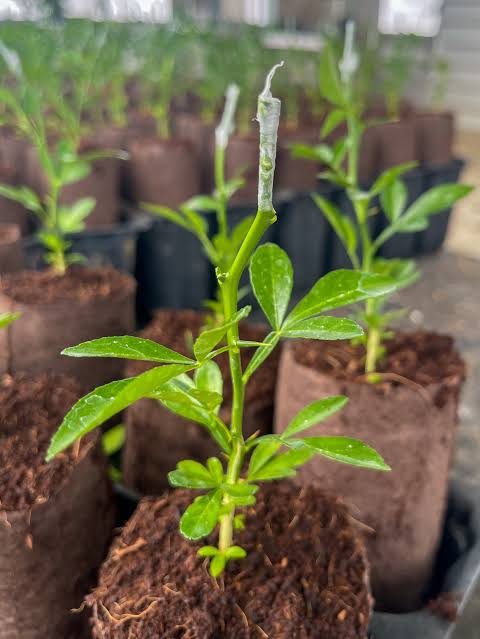
C-35 Rootstock Care Protocol
Botanical: Citrus × insitorum / Poncirus trifoliata hybrid · Mature orchard height: 10-15 ft
6–8 hours of full sunlight (or 30% shade net in nursery beds)
5.5 – 7.5 (depends on rootstock: Rangpur tolerates alkaline/saline; Carrizo/Swingle prefer 6.0–7.0)
Even moisture to maintain active cambium sap flow for budding
Deep nursery polybag (8×12 or 10×14 inch) to prevent J-rooting of the taproot
22°C – 34°C
Ready for T-budding / Cleft grafting when stem caliper reaches 6–8 mm (pencil thickness)
Beginner · Taproot Care, Repotting & Single-Stem Training
Grow a straight, vigorous, pencil-thick stem ready for grafting or orchard foundation.
1. Never Bend the Taproot ("J-Root" Prevention)
Rootstock vigour depends on a straight vertical taproot. Always use deep polybags or deep pots (at least 12–14 inches deep) and ensure the main root points straight down when potting.
2. Sterile, Disease-Free Nursery Media
Use solarized/clean mix: 40% sand + 40% loamy soil + 20% vermicompost enriched with Trichoderma viride (5 g/pot).
3. Single-Leader Desuckering
Strip all side shoots along the bottom 25–30 cm of the stem while they are soft so the plant grows as a single, smooth, straight whip.
4. Stake Vertically
Tie the stem to a straight bamboo split so the budding zone (15–25 cm height) remains perfectly straight.
Advanced · Cambium Sap-Flow Nutrition & Budding Readiness
Prepare active, slipping bark for 95%+ grafting and budding success.
1. High-Vigour Vegetative Nutrition
Feed every 21 days with balanced 19:19:19 (2 g/L foliar or soil drench) + humic acid to push rapid stem caliper growth to 6–8 mm (pencil thickness).
2. Pre-Budding Irrigation ("Bark Slipping")
Water thoroughly for 5 days before grafting/budding so the vascular cambium is actively dividing and the bark peels ("slips") cleanly without tearing.
3. Rootstock Selection by Soil Type
Use Rangpur Lime for drought/saline/heavy soils; Carrizo/C-35 Citrange for high fruit quality in loamy soils; Swingle Citrumelo for Phytophthora and nematode resistance; X-639 for calcareous soils.
4. Keep Foliage 100% Canker & Miner Free
Protect leaves with regular Neem Oil (5 ml/L) sprays so photosynthetic capacity stays high during graft healing.
Expert · T-Budding / Cleft Grafting Protocol & Post-Union Forcing
Professional nursery propagation at 15–20 cm height for certified disease-free trees.
1. High Budding at 15–20 cm Above Collar
Perform shield T-budding, chip budding, or cleft grafting at 15–20 cm height using surface-sterilized (1% sodium hypochlorite) grafting knives and certified scion budwood.
2. 21-Day Paraffin/Polythene Tape Wrap
Wrap the bud union tightly with 100-gauge grafting tape (leaving the bud eye exposed in warm weather or covered in dry weather). Unwrap after 18–21 days if the bud petiole drops cleanly at a touch and the shield remains green.
3. Lopping / Heading Back to Force Scion Push
Once the bud union heals (day 21), cut the rootstock stem halfway through 5 cm above the bud and bend it over ("lopping") to break apical dominance; make the final clean 45° cut 1 cm above the scion shoot once it reaches 10 cm.
4. Strict Nucellar & Virus Indexing Hygiene
Remove all rootstock sprouts below the union every 5 days during scion elongation and sterilize secateurs between plants.
Browse Care Guides by Plant Family
Click any variety to load its Beginner, Advanced & Expert protocol
Grapefruit Care Guide
6–8+ hours of warm, direct sunlight · Soil pH 5.8 – 7.0 (deep, fertile, well-drained sandy loam)
Lime/Lemon Care Guide
6–8 hours of direct sunlight (ideal for balconies, terraces & gardens) · Soil pH 5.5 – 7.0 (fast-draining, fertile sandy loam)
Mandarin Care Guide
6–8 hours of direct sunlight (morning sun is essential) · Soil pH 5.5 – 6.8 (friable, humus-rich, well-drained soil)
Mango Care Guide
6–8+ hours of direct daily sunlight · Soil pH 5.5 – 7.0 (slightly acidic to neutral, well-drained loam)
Mosambi Care Guide
6–8 hours of full direct sun · Soil pH 6.0 – 7.5 (well-drained loamy soil)
Root Stock Care Guide
6–8 hours of full sunlight (or 30% shade net in nursery beds) · Soil pH 5.5 – 7.5 (depends on rootstock: Rangpur tolerates alkaline/saline; Carrizo/Swingle prefer 6.0–7.0)
Sweet Orange Care Guide
6–8 hours of direct sunlight daily · Soil pH 6.0 – 7.0 (well-aerated, slightly acidic sandy loam)