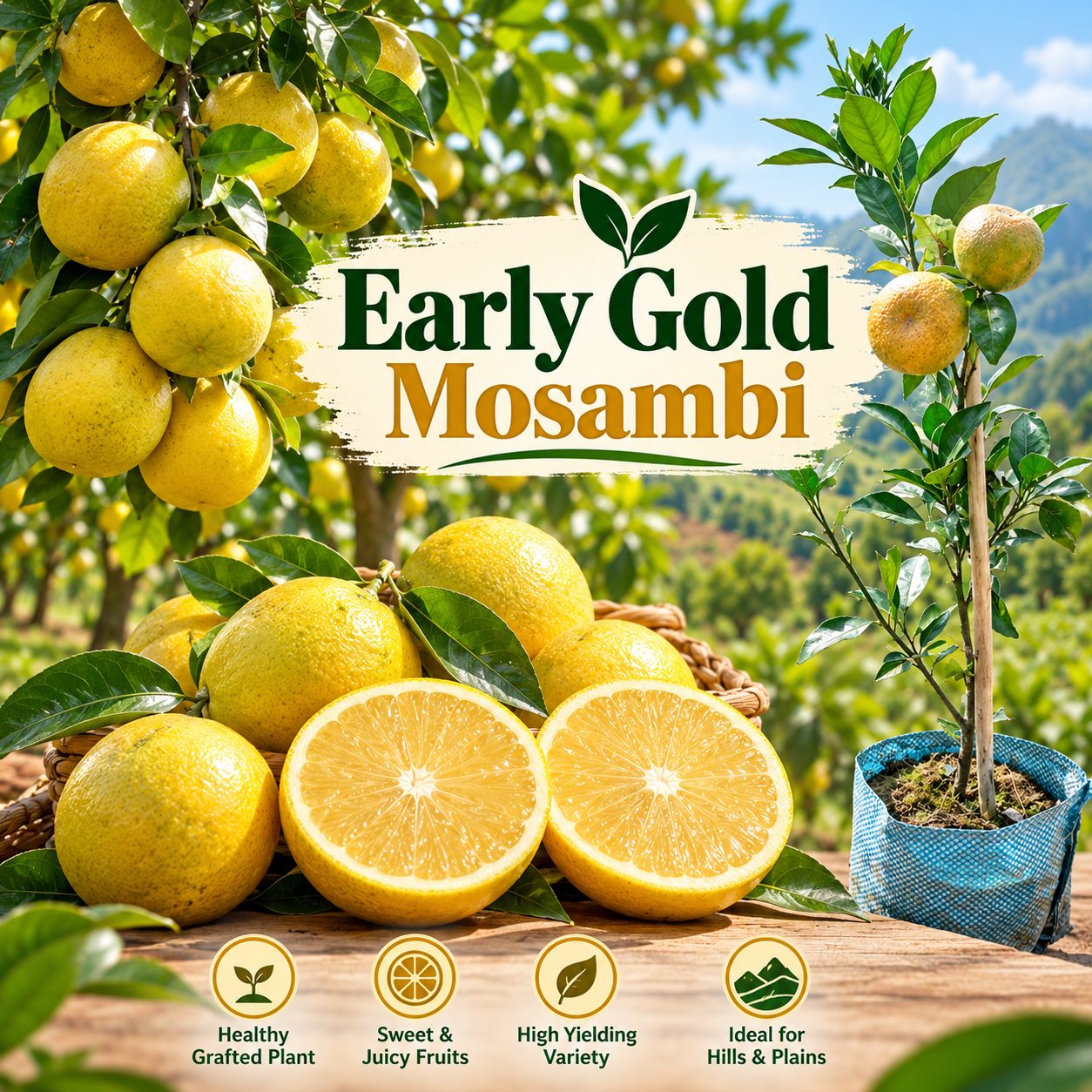
Early Gold Care Protocol
Botanical: Citrus limetta · Mature orchard height: 10-15 ft
6–8 hours of full direct sun
6.0 – 7.5 (well-drained loamy soil)
Regular deep watering during dry months; zero waterlogging in monsoon
16–20 inch container or open ground pit (60×60×60 cm)
20°C – 36°C (highly adaptable to Indian plains and plateaus)
2–3 years; low-acid, high-juice sweet fruits
Beginner · Potting, Sun & Rootstock Sucker Removal
Simple foundation care for Katol Gold, Bari-1 & ICAR Mosambi saplings.
1. Unbox, Hydrate & Acclimatize
Water the root ball upon arrival and keep in semi-shade for 3–4 days before shifting to full sunlight.
2. Well-Drained Loam Mix
Use 50% garden soil + 25% vermicompost + 25% river sand + 50 g neem cake. Ensure the pot has at least 4–6 bottom drainage holes.
3. Full Sun Exposure
Mosambi requires at least 6 hours of direct sunlight to produce sweet juice; shaded plants stay leafy without flowering.
4. Sucker Check Below Graft Line
Check the lower 15 cm of the stem monthly and pinch off any fast-growing thorny shoots below the graft union.
Advanced · Ambe / Mrig Bahar Flowering & Micronutrients
Synchronize flowering and prevent premature fruit drop.
1. Bahar (Flowering) Regulation
For spring bloom (Ambe Bahar, Jan–Feb), reduce watering for 3 weeks in December, then apply 2 kg vermicompost + 100 g neem cake + 30 g bone meal and irrigate thoroughly.
2. Micronutrient Spray on New Flushes
Spray Zinc + Iron + Boron micronutrient mix (2 g/L) when new leaves are half-expanded to keep foliage dark glossy green.
3. Organic Pest Shield
Apply Neem Oil (5 ml/L) every 10–14 days during new flush emergence to deter citrus psylla, aphids, and leaf miner.
4. Even Moisture During Fruit Swell
Maintain consistent soil moisture from April to August; sudden dry-wet cycles cause Mosambi fruits to split.
Expert · Juice Content Maximization & Greening/Canker Defense
Advanced orchard nutrition for thin skin, high juice recovery, and tree longevity.
1. Fruit Retention & Size Booster
Spray NAA (10 ppm) + 00:52:34 (5 g/L) at marble stage, followed by Potassium Sulphate (00:00:50 at 5 g/L) twice at 20-day intervals during fruit development.
2. Citrus Psylla Vector Control
Monitor flush tips with yellow sticky traps. Controlling citrus psylla early is critical to protect trees from citrus greening (HLB).
3. Trichoderma & Pseudomonas Bio-Shield
Apply 25 g Trichoderma harzianum + 25 g Pseudomonas fluorescens mixed in 2 kg damp vermicompost around the root zone every 6 months.
4. Harvest at Optimal Juice Percentage (45%+)
Harvest when the dark green rind turns light yellowish-green and oil glands become prominent with a smooth sheen.
Browse Care Guides by Plant Family
Click any variety to load its Beginner, Advanced & Expert protocol
Grapefruit Care Guide
6–8+ hours of warm, direct sunlight · Soil pH 5.8 – 7.0 (deep, fertile, well-drained sandy loam)
Lime/Lemon Care Guide
6–8 hours of direct sunlight (ideal for balconies, terraces & gardens) · Soil pH 5.5 – 7.0 (fast-draining, fertile sandy loam)
Mandarin Care Guide
6–8 hours of direct sunlight (morning sun is essential) · Soil pH 5.5 – 6.8 (friable, humus-rich, well-drained soil)
Mango Care Guide
6–8+ hours of direct daily sunlight · Soil pH 5.5 – 7.0 (slightly acidic to neutral, well-drained loam)
Mosambi Care Guide
6–8 hours of full direct sun · Soil pH 6.0 – 7.5 (well-drained loamy soil)
Root Stock Care Guide
6–8 hours of full sunlight (or 30% shade net in nursery beds) · Soil pH 5.5 – 7.5 (depends on rootstock: Rangpur tolerates alkaline/saline; Carrizo/Swingle prefer 6.0–7.0)
Sweet Orange Care Guide
6–8 hours of direct sunlight daily · Soil pH 6.0 – 7.0 (well-aerated, slightly acidic sandy loam)