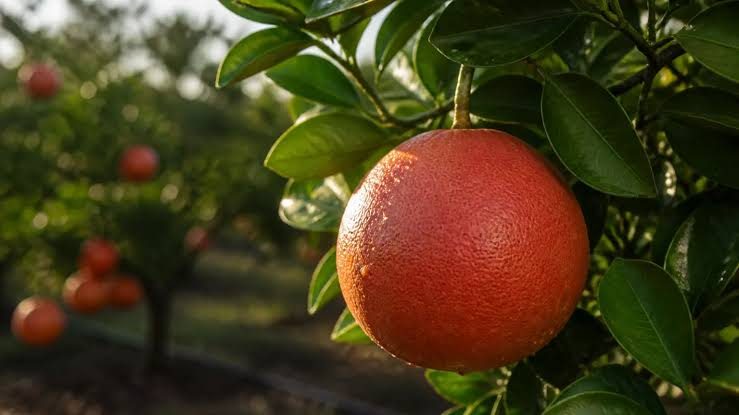
Red Grapefruit Care Protocol
Botanical: Citrus × paradisi · Mature orchard height: 10-15 ft
6–8+ hours of warm, direct sunlight
5.8 – 7.0 (deep, fertile, well-drained sandy loam)
Deep watering every 4–7 days; drought-tolerant once established but needs moisture during fruit swell
18–24 inch large container / half-barrel or open ground
20°C – 35°C (warm summers develop ruby-red lycopene flesh)
2–3 years; large, antioxidant-rich ruby/pink fruits
Beginner · Potting, Sun & First-Season Establishment
Set up your Flame, Red Blush, or Ruby Grapefruit sapling for vigorous growth.
1. Unbox & Shade Acclimatization
Hydrate the root ball and rest the sapling in bright shade for 3–4 days before moving to full sun.
2. Spacious Container or Ground Pit
Grapefruit trees are vigorous with large leaves. Use at least an 18-inch pot filled with 50% loam + 25% compost + 20% sand + 5% neem cake.
3. Warm, Sunny Exposure
Give 6–8 hours of direct sun; warm temperatures are required to break down acidity and develop sweet pink/red pigment.
4. Keep the Graft High & Clean
Ensure the graft union sits 10 cm above the soil and remove any rootstock sprouts below it.
Advanced · Cluster Thinning, Branch Support & Nutrition
Grapefruit gets its name from fruiting in grape-like clusters—manage load for big fruits.
1. Cluster Thinning to 1–2 Fruits per Shoot
When fruitlets reach golf-ball size, thin clusters to 1–2 well-spaced fruits so each fruit reaches full size (350–500 g) without snapping branches.
2. Balanced Organic + Potash Nutrition
Feed 3 times a year (Feb, June, Oct) with 2.5 kg vermicompost + 100 g neem cake + 50 g bone meal + 25 g sulphate of potash.
3. Magnesium & Zinc Foliar Care
Large grapefruit leaves draw heavy Magnesium during fruit fill; spray MgSO4 (3 g/L) + chelated Zinc (1.5 g/L) in May and August.
4. Fruit Fly Trap Installation
Hang a Methyl Eugenol / Cuelure pheromone trap or wrap maturing fruits in breathable paper bags 60 days before harvest.
Expert · Lycopene Coloration, Brix:Acid Ratio & Canopy Architecture
Maximize ruby internal pigment, thin rind, and long on-tree storage.
1. Potassium & Calcium for Thin Rind & High Juice
Apply two foliar sprays of Potassium Sulphate (00:00:50 at 5 g/L) in August and September to reduce rind thickness and elevate sugar-to-acid ratio.
2. Open-Center Structural Pruning
Maintain 3–4 wide-angled main scaffold limbs with an open center so interior fruiting spurs receive filtered light (interior shaded fruits actually develop deeper ruby lycopene blush).
3. Collar Rot & Gummosis Prophylaxis
Apply Bordeaux paste to the trunk base pre-monsoon and drench soil with Trichoderma viride.
4. Tree-Storage Harvesting Strategy
Mature grapefruits can "store on the tree" for 4–8 weeks after ripening, progressively losing acidity and becoming sweeter.
Browse Care Guides by Plant Family
Click any variety to load its Beginner, Advanced & Expert protocol
Grapefruit Care Guide
6–8+ hours of warm, direct sunlight · Soil pH 5.8 – 7.0 (deep, fertile, well-drained sandy loam)
Lime/Lemon Care Guide
6–8 hours of direct sunlight (ideal for balconies, terraces & gardens) · Soil pH 5.5 – 7.0 (fast-draining, fertile sandy loam)
Mandarin Care Guide
6–8 hours of direct sunlight (morning sun is essential) · Soil pH 5.5 – 6.8 (friable, humus-rich, well-drained soil)
Mango Care Guide
6–8+ hours of direct daily sunlight · Soil pH 5.5 – 7.0 (slightly acidic to neutral, well-drained loam)
Mosambi Care Guide
6–8 hours of full direct sun · Soil pH 6.0 – 7.5 (well-drained loamy soil)
Root Stock Care Guide
6–8 hours of full sunlight (or 30% shade net in nursery beds) · Soil pH 5.5 – 7.5 (depends on rootstock: Rangpur tolerates alkaline/saline; Carrizo/Swingle prefer 6.0–7.0)
Sweet Orange Care Guide
6–8 hours of direct sunlight daily · Soil pH 6.0 – 7.0 (well-aerated, slightly acidic sandy loam)